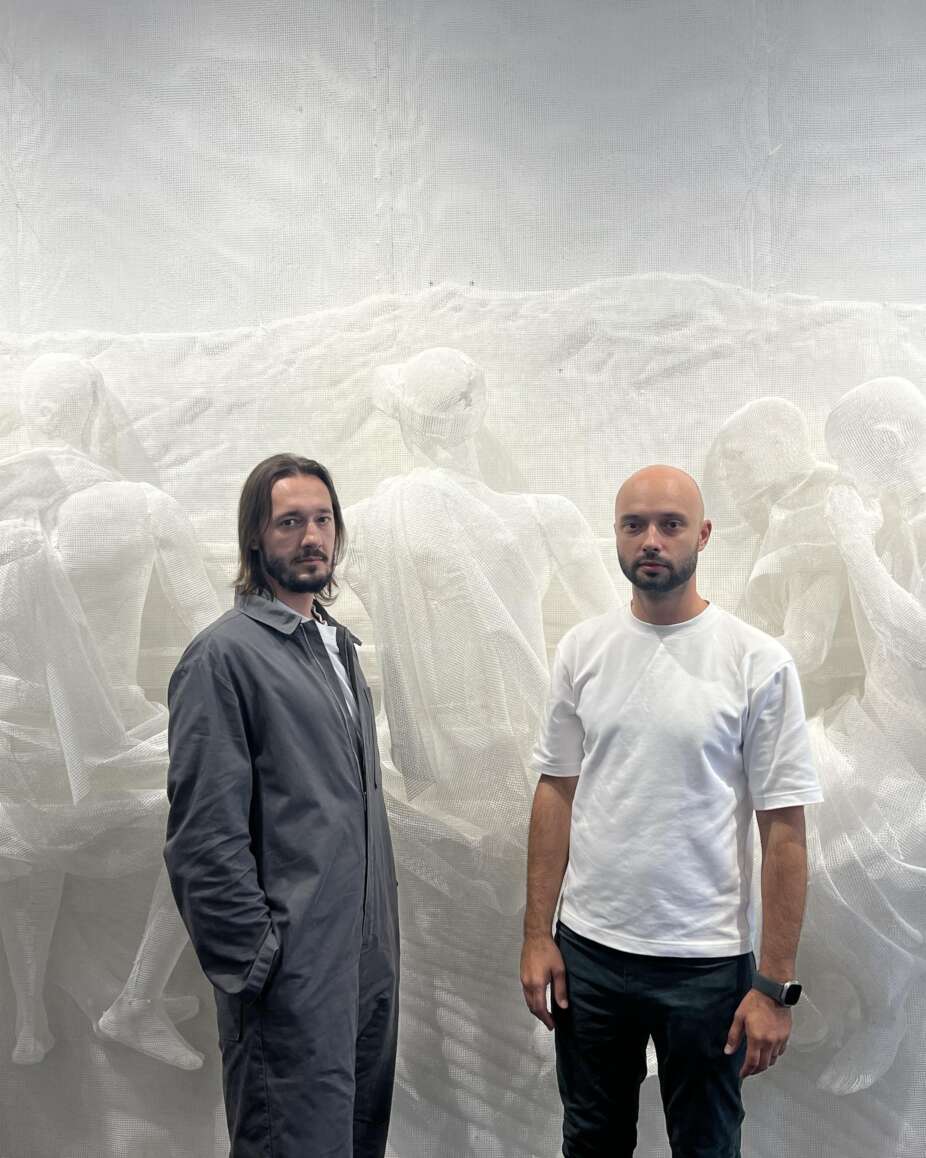
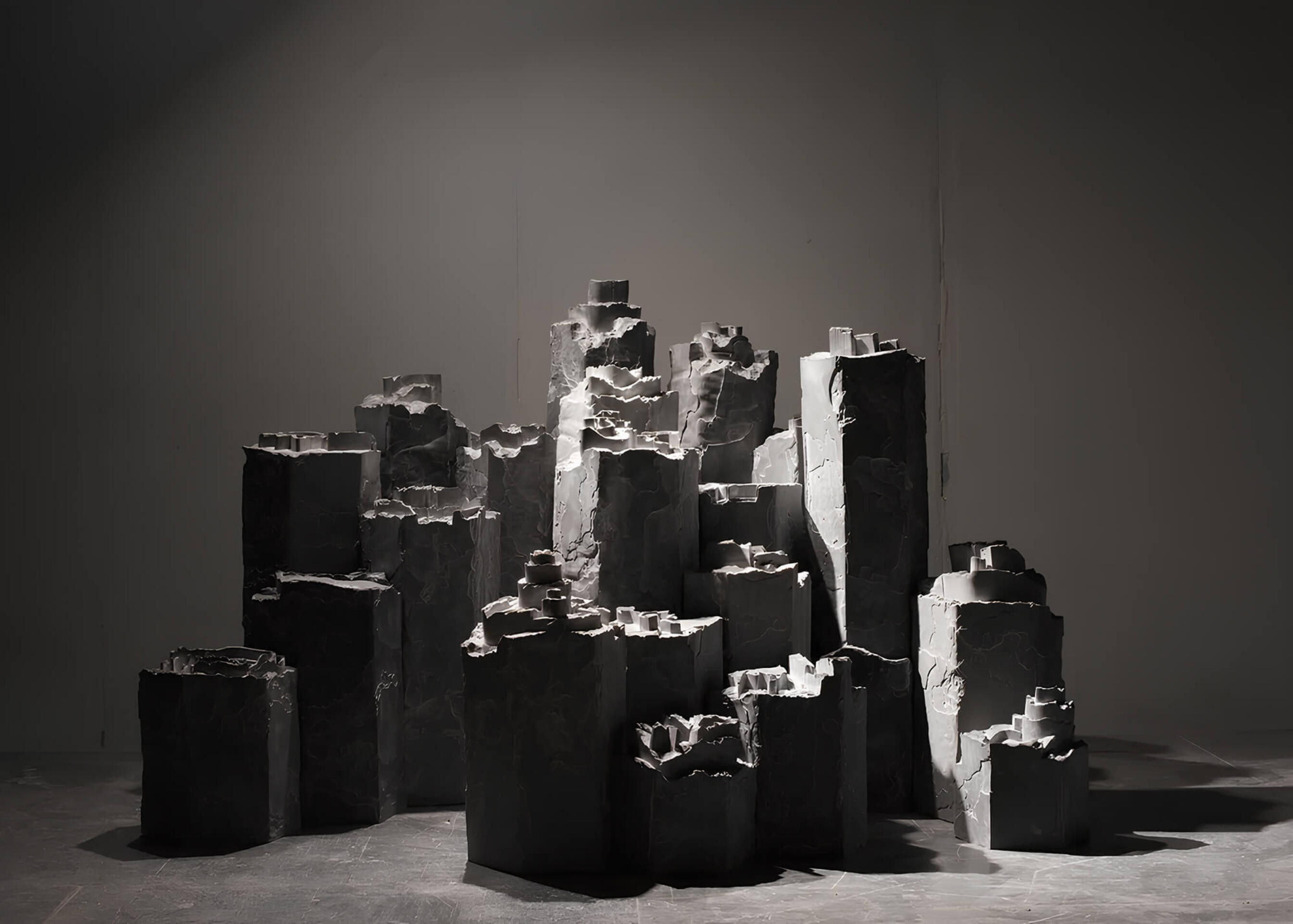
The internationally active artist duo Recycle Group, consisting of Andrey Blokhin and Georgy Kuznetsov, is designing the stage and sculptures for the new production of »Das Rheingold.«
What was the founding idea behind Recycle Group and how has it developed conceptually?
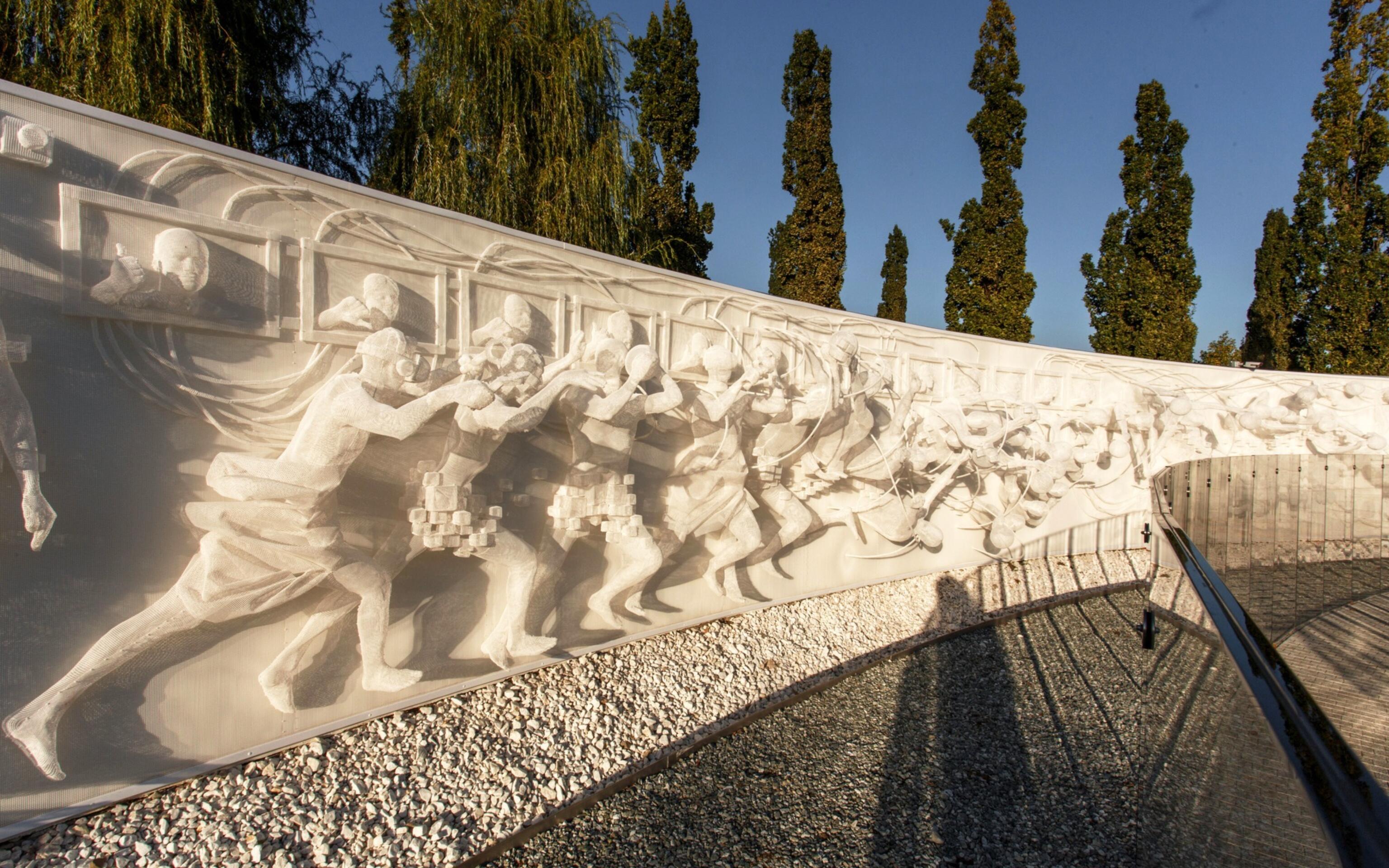
Andrey Blokhin: »Recycle« was the title of our first joint exhibition, and we later kept it as the name of our group. The original concept of the exhibition revolved around one question: can art be recycled, that is, reworked or reused? We still ask ourselves these questions and seek answers through our art: what can happen to art, how can it transform, is it possible to recycle it? Will it remain art in the process—or will it turn into a heap of garbage, and where is that line drawn? Over the course of our creative journey, these ideas have continuously evolved and grown more complex.
Georgy Kuznetsov: Around the same time, reflections on digital space began to appear in our practice, which we started to implement in concrete projects. One of the first of these was »Units of Happiness« for mobile phones. At a time when MMS was still widely used, we devised a
project in which physical cards with codes (in the 2010s, such cards were used to top up mobile phone balances) could be used to add to a virtual account—not with money, but with units of happiness. This was our first experience working on an entirely immaterial project. Later, we continued to explore and develop ideas related to virtual space, its role, and its possibilities in human life.
You work as an artist duo—how does your joint creative process generally work and, more specifically, how did it work for the opera production »Das Rheingold«?
AB: Our collaborative work is somewhat like playing ping-pong. We take an idea, discuss it, sometimes push it to the point of absurdity, and then transform it into a concept that finds its expression in the artwork.
GK: Sometimes this ping-pong game expands into a full chorus of voices and opinions (laughs). Since we have a large technical team in the studio that handles the production of objects, discussions often turn into heated debates and intensive brainstorming sessions aimed at developing new technological solutions for realizing the work.
AB: As for working on the opera »Das Rheingold«, we had been in contact with director Kirill Serebrennikov for a long time and were very happy that he invited us to join this project and gave us the opportunity to collaborate. It all began with a careful discussion of the idea with the opera team: we talked about Kirill’s vision as a director, what the production would be like, and its overall concept. Then Georgy and I would dive into the details, make sketches, and return to discussions with the production team, transforming ideas and the forms of the sculptures.
It’s important to note that the process is still ongoing: we continue to add, adjust, and manage changes, because it’s a living, evolving process. This is, in fact, our first experience working in theater—we had never created stage sets for theatrical productions before.
GK: In short, the process of working on »Das Rheingold« has been dynamic and evolving from the outset. First, we met with the team, and then we travelled to Salzburg to view the stage in person. Kirill’s interpretation of the opera tells a story set in a sort of futuristic future connected to the »Ring des Nibelungen«. It stands out noticeably from other interpretations of this opera, where the action has almost always referred to the past—myths, legends, or historical fantasies. In our case, however, it is a story about the future: an apocalyptic, fragile future, transformed into something indeterminate. It is, in a sense, a post-post-era—a state in which humanity has gone through all the cycles of modern civilization, with its rituals, religions, and social structures, and has reached a new stage, where, conversely, a return to primitivism begins.It was precisely from this perspective on the story that we found it incredibly exciting to create visual images of the sculptures, capable of revealing this layer of meaning in all its magnitude.
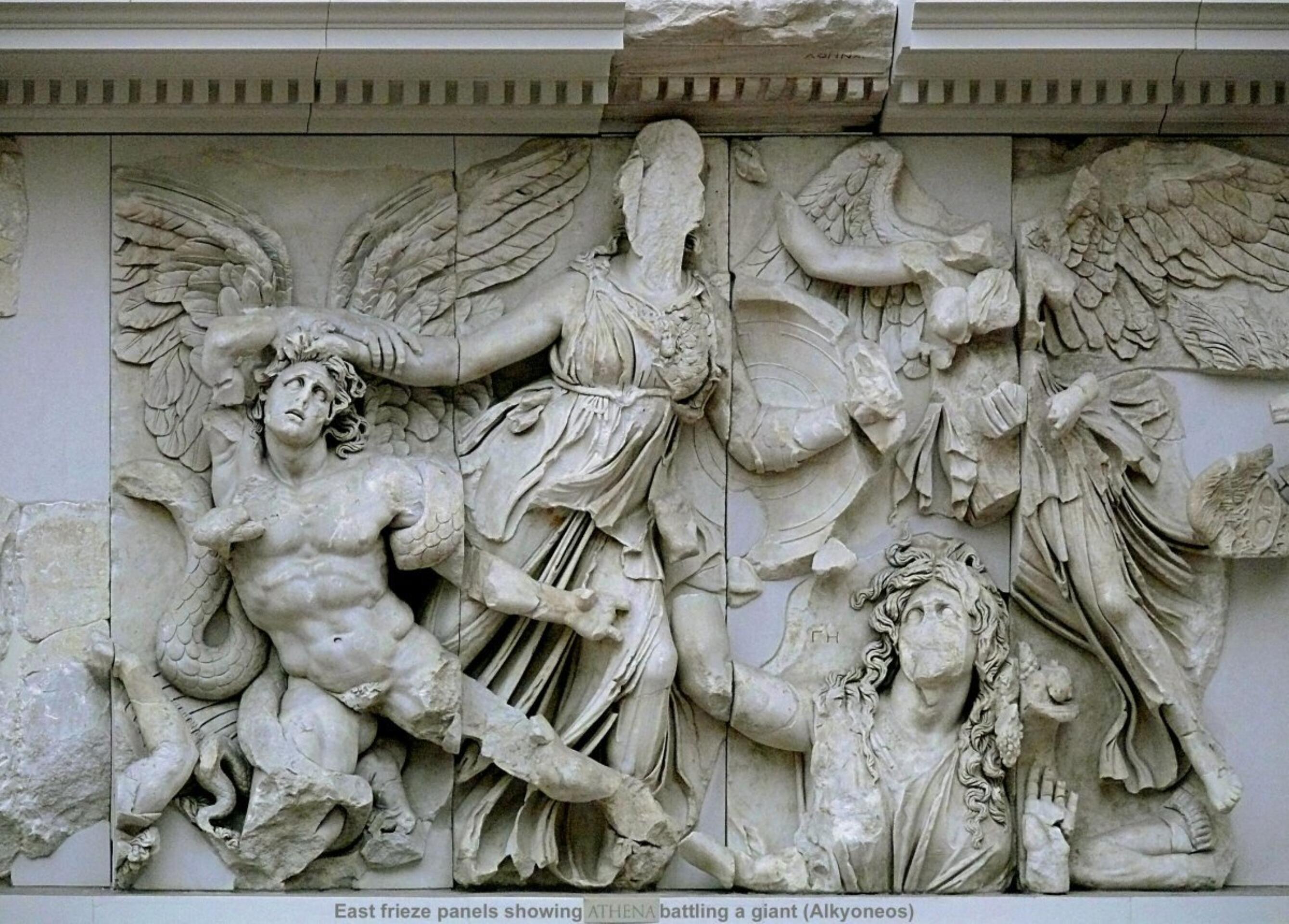
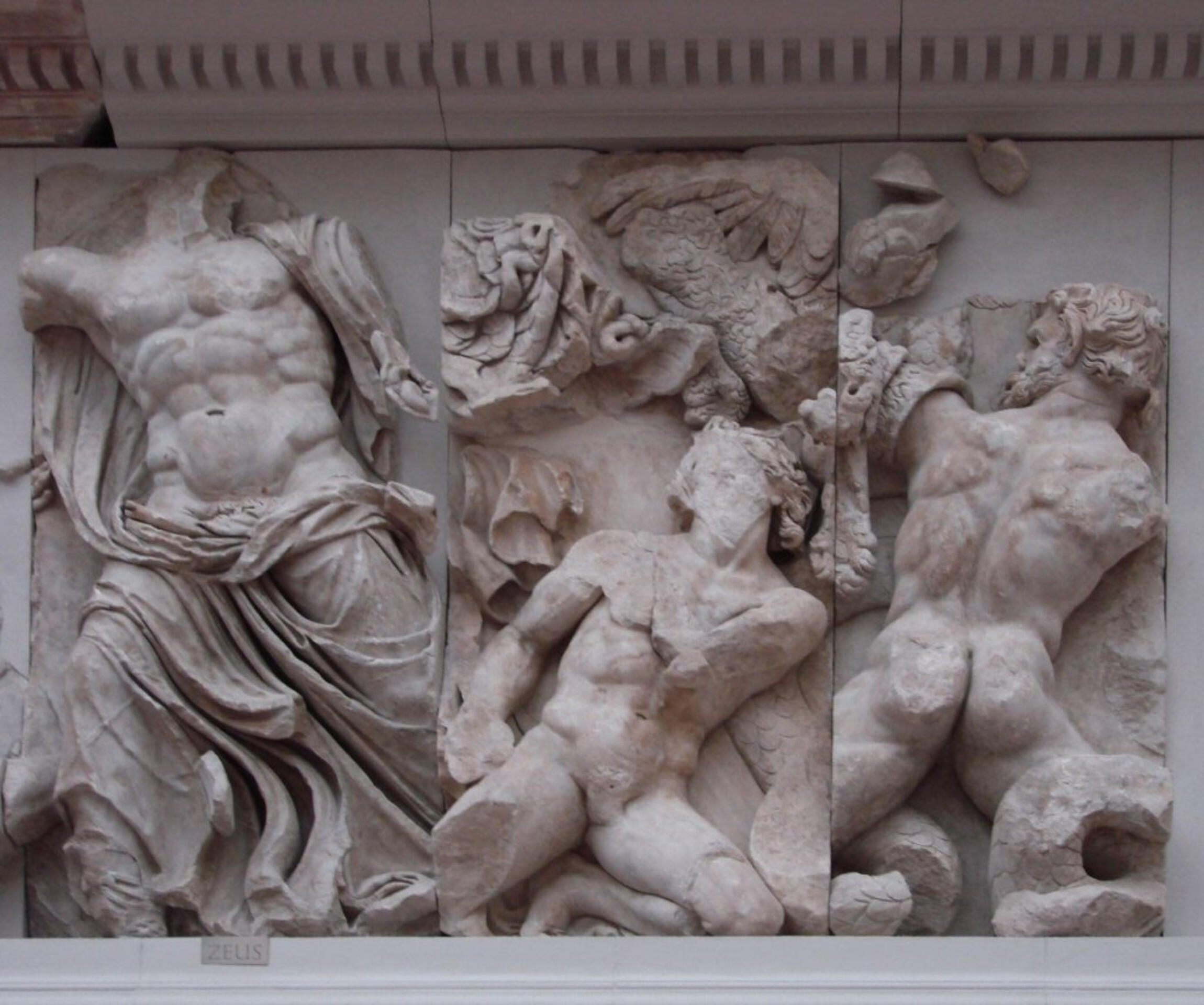
Inspirations for »Das Rheingold«: details from the relief of the Pergamon Altar in Berlin
1/3
Have you ever designed for a theater stage before? How does thinking for theater differ from thinking for a museum or gallery?
GK: We have quite an active exhibition practice, yet we had never worked in theater—and especially not in opera—before. This experience, therefore, became truly unique for us. On top of that, we were immediately involved in working on »Das Rheingold«—we had never tackled a project of this scale before, as the work itself is incredibly vast and epic.
AB: For us as artists, the experience of creating sculptures for an opera became a kind of major challenge—primarily a technical one. In the stage space, sculptures cease to be autonomous objects and become part of the environment with which the performers interact.
GK: Although in our artistic practice we often incorporate possibilities for audience interaction with our objects, interactivity in gallery or museum sculpture is still relatively rare.
AB: Exactly. The sculptures created for »Das Rheingold« acquire a practical dimension: the performers have to interact with them, and art transforms into a kind of objective action. It is crucial to understand why this happens, how the gesture is woven into the ritual of the performance itself, and how the sculptures relate to the body’s movement. As a result, it is no longer just sculpture—it becomes a special object in which a symbiosis of performance and sculptural form arises.
What is the inspiration for the sculptures you designed for »Das Rheingold«?
AB: Since Kirill was already familiar with our art and the themes we work with, by inviting us to participate in the opera production. Our main source of inspiration became the universal, deeply human themes embedded in the opera: the theme of the gods, as well as the diverse
landscapes present within the work itself.
GK: Strange as it may sound, we initially drew on themes we have been exploring for a long time—the impact of technology on humans, the archaeology of the future, and the question of what will remain in the cultural layer of contemporary humanity. We transferred and reinterpreted all these motifs within the context of the opera.
»In our case, however, it is a story about the future: an apocalyptic, fragile future, transformed into something indeterminate.«
Can you describe in more detail what the audience can look forward to?
GK: I think it’s hard to describe in just a few words… But I can say for certain that the audience has never seen anything like this before!
AB: Yes, the universe and the unique world that Kirill creates in his direction can be described as both grotesque and even strange. The audience will not find themselves in the familiar context of the past, but will be transported into a transformed world of the future—a time when people are already beginning to lose their human qualities.
The Felsenreitschule is a unique space. To what extent does its striking architecture influence your designs?
AB: The Felsenreitschule stage itself is truly a unique space. Naturally, it plays a key role, since its architecture shapes the landscape and scenery of the production. Working in a theater is a constant dialogue with the space: either you find a way to communicate with it, or you start struggling against it. But such a struggle is like fighting gravity—the space will inevitably be stronger. That’s why it’s important to establish a dialogue with it. That was our idea: to find a conversation with this space and to use its beauty.
GK: The stage is literally carved into the rock, and it is completely unusual. On the other hand, it didn’t feel fundamentally new to us: for people who work in theater constantly, this may be an especially challenging experience, but for us, working in opera is, overall, a first. In a way, it’s simply another space with which we interact as artists. Moreover, there is almost no backstage, and nothing can be hidden behind the stage or concealed in the set. This adds certain, including technical, challenges, which, however, turned out to be particularly fascinating for us.
What are your most important works to date? And why?
GK: I think it’s difficult for us to single out a few key works; for us, the themes we explore are more important.
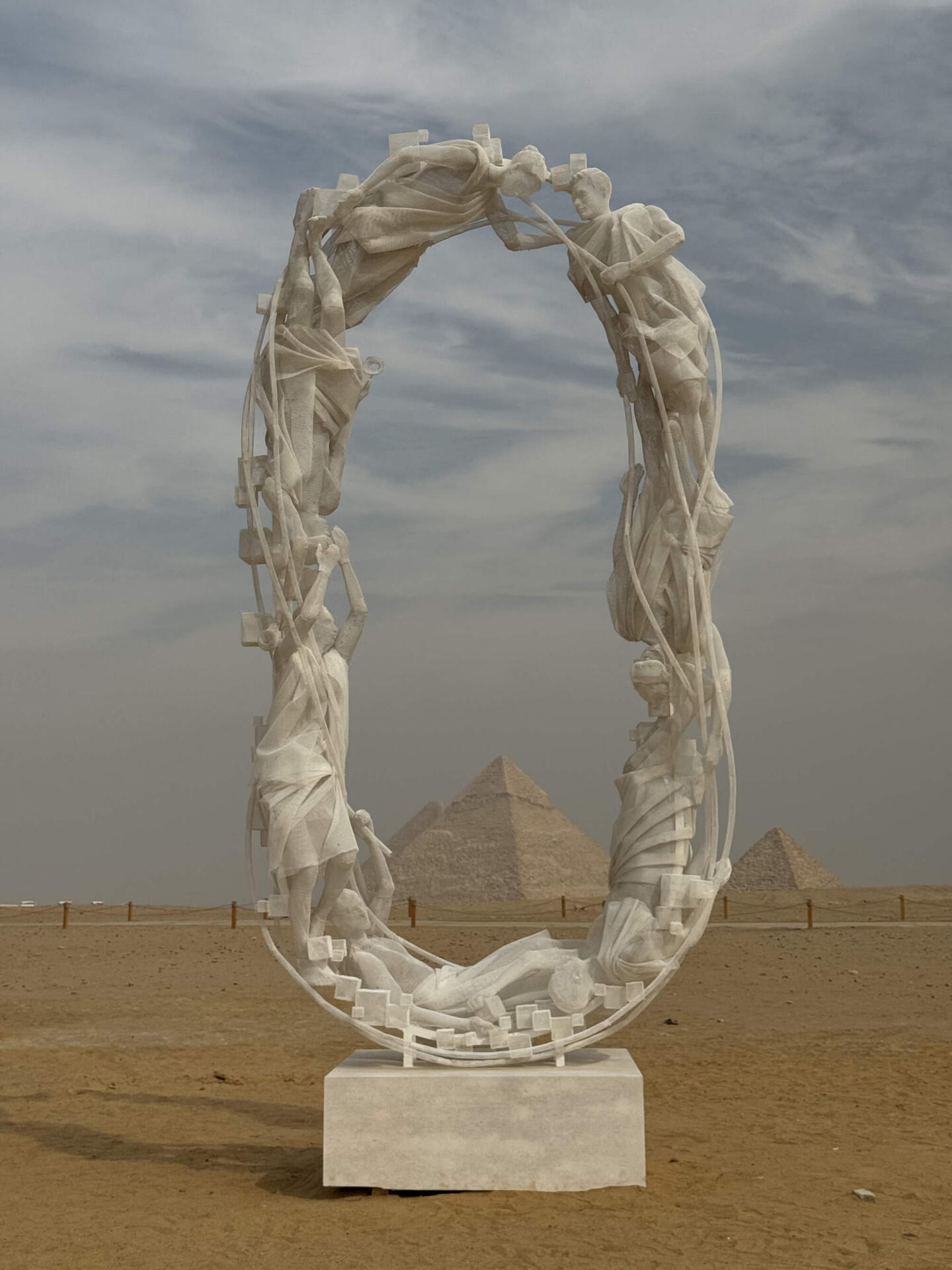
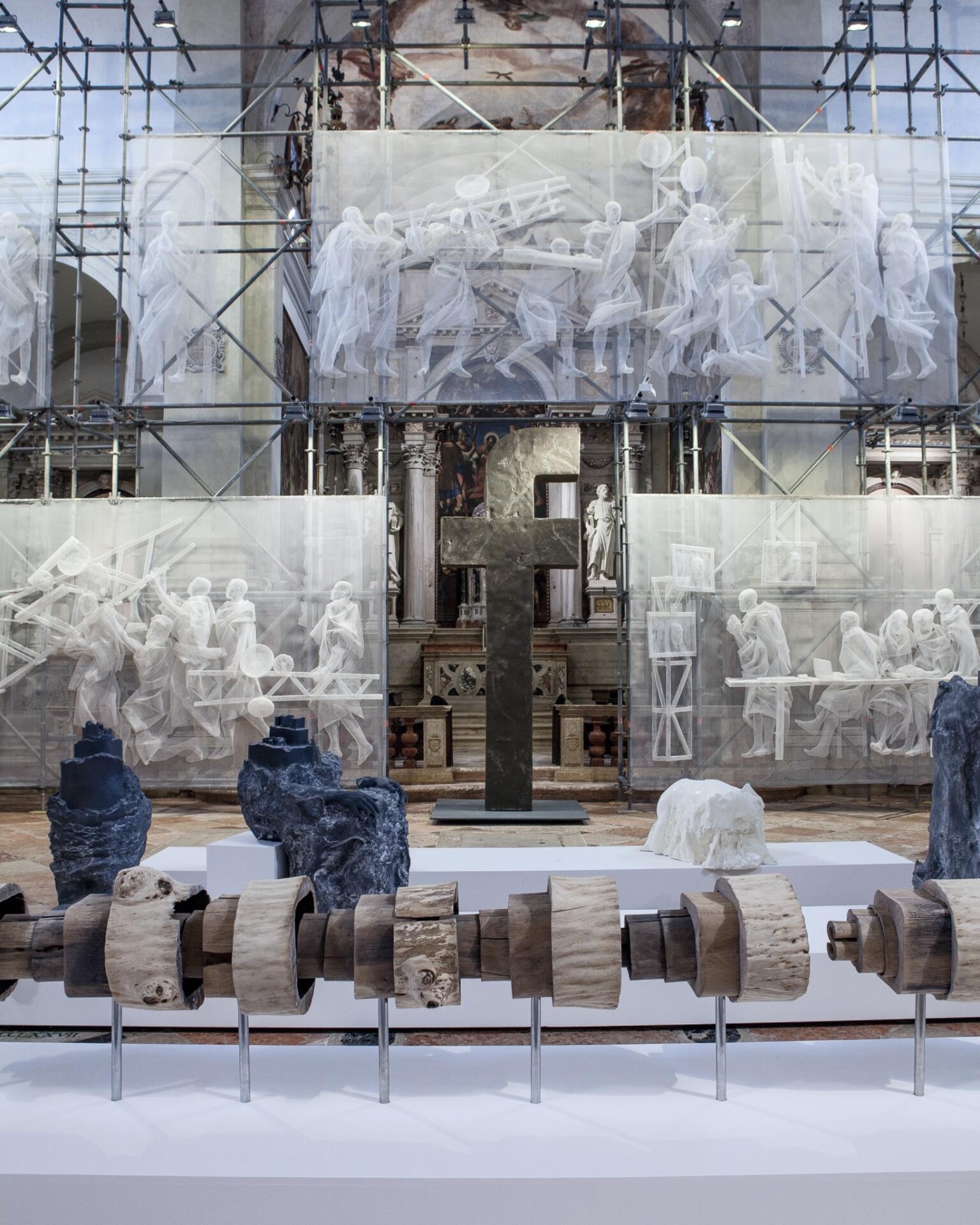
AB: Although, I suppose, one example could be the work »Facebook,« created in the form of a curved cross. Also, there is the series of sculptures called »Zero,« existing in various incarnations but united by the overarching theme of zero as a transitional state between the physical world and digital reality—a liminal point between worlds. One of the latest realizations of this idea was a sculpture made specifically for the exhibition project Forever Is Now and shown in November 2025 on the Giza Plateau.
GK: Yes, there are certain symbols that are key to our artistic practice, which we use repeatedly and which over time become a reference point for entire projects. Broadly speaking, two factors are at work here. The first is the work whose idea opens a new stage for us: a concept arises, gradually matures, and then moves to the next level. In this sense, our entire practice resembles spiral growth—a successive development of a single concept. The second factor is related to technology: if a new technological basis is developed for a specific project, that project usually carries a new conceptual load as well.
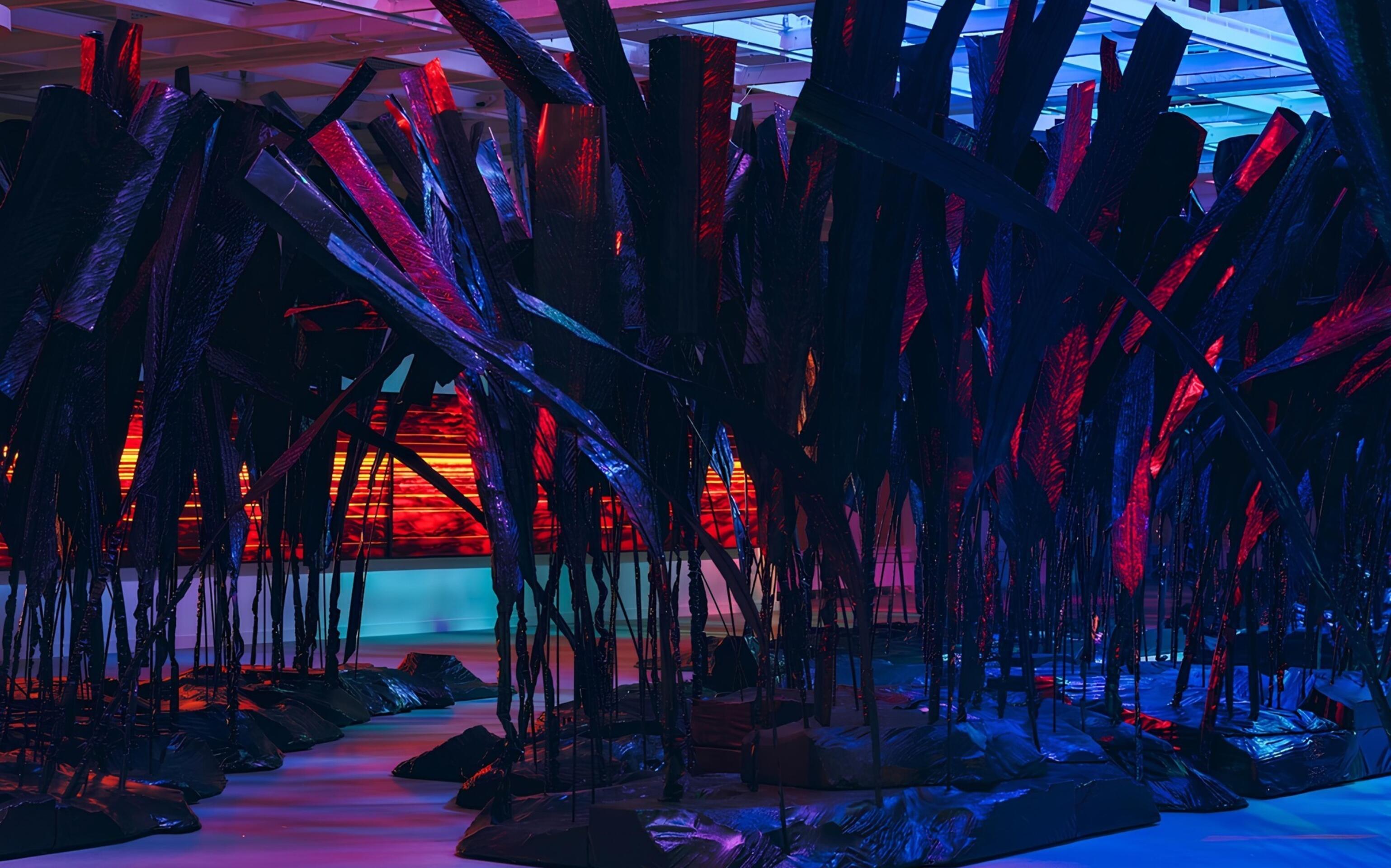
AB: For example, the series of sculptures visually reminiscent of trash bins, and especially the first work in this series, »Sarcophagus.« But ultimately, it’s always a matter of balance: technology is important, yet the idea remains primary.
If you could have a date with an artist, who would you choose and what would you ask him or her? What drink would be served and why?
GK: I think Marcel Duchamp—absolutely, 100 percent. Yes, number one, no question. It would be amazing to have a conversation with Duchamp. What would I ask him? One question wouldn’t be enough, of course. But the first thing that comes to mind: did he actually use the urinal as intended? (laughs)
AB: And I’d also ask which of his own works he stole himself. As far as I know, there were episodes like that in his biography. And as for the drink, we’d definitely share tequila with him.
GK: I’d also like to »summon« the creator of the Venus of Willendorf. Yes, it would be extremely interesting to ask why they created it, what it was for, and what drove them.