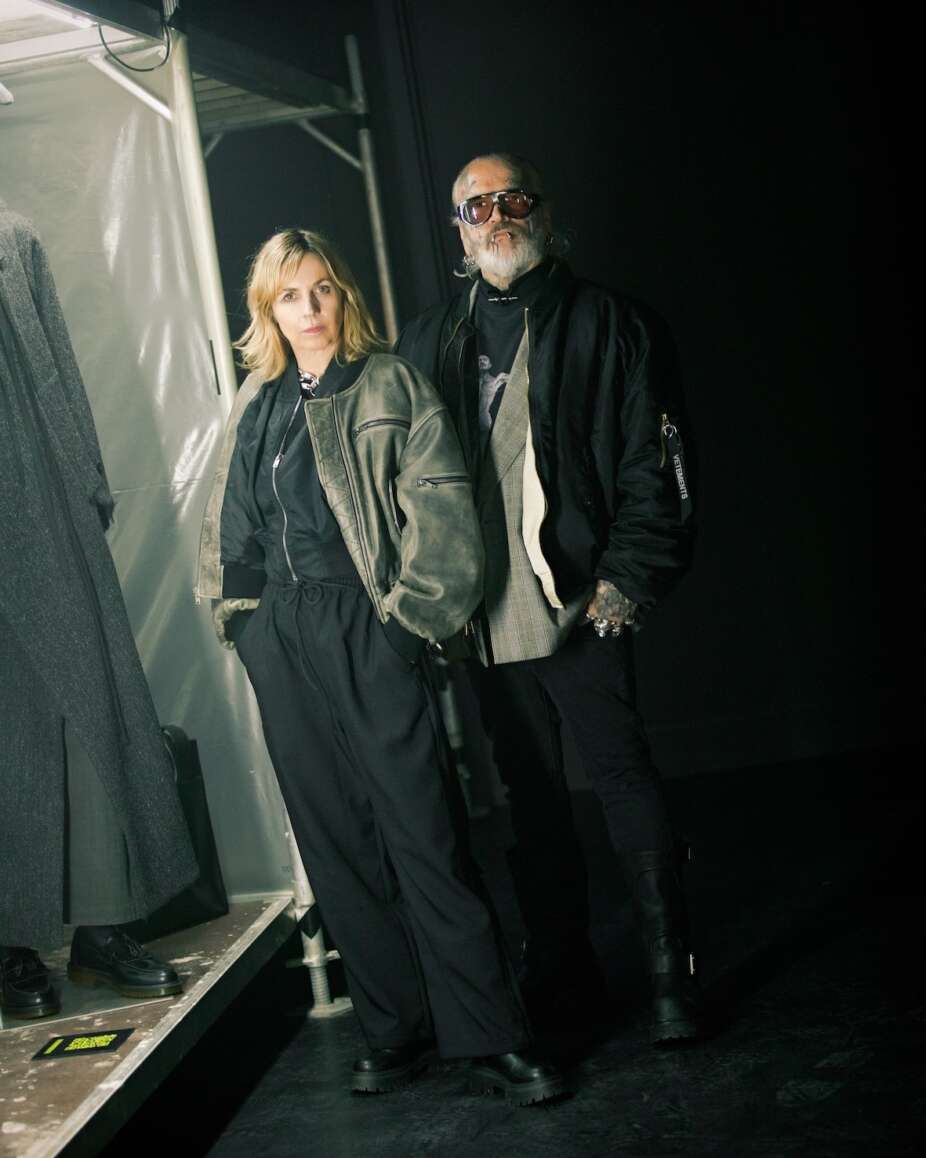
Anja Schneider and Sven Marquardt reinterpret Richard Wagner’s »Ring« with »Heartbroken«. Learn more in a conversation with Sabine Röthig about electronic music, black-and-white photography, and a seated audience.
Anja, how did you approach Richard Wagner’s»Ring des Nibelungen«?
Anja Schneider: Of course, I first immersed myself deeply in Wagner, read a lot, and listened to different interpretations of the work. In the end, however, what mattered most for my work was less the music itself and more the story told in the Nibelung saga. That may be because I also think of my DJ sets as stories - the stories of an evening. During long club nights, these great catastrophes of love and betrayal happen on a small scale just as they do in the legend that underlies the Ring.
Why did you want to collaborate with Sven Marquardt for the performance?
Anja Schneider: I’ve known Sven for a long time; we already worked together years ago. I know his story very well, I’ve read his book, I regularly go to his exhibitions - and he was also a guest on my podcast. I simply love his work. When I saw »Disturbing Beauty« in Berlin a few weeks ago, I was very inspired. Sven’s works were projected onto the walls and a pianist played alongside them, which gave the room a very special atmosphere. Ultimately, that total work of art was decisive in my decision to invite Sven. The deep emotions it conveyed are something we also encounter in Wagner. I also quickly realized that it wouldn’t be enough for me to approach the project purely musically. I believe in the interplay of different artistic disciplines. In clubs, visuals also play a major role.
Sven, what did you think when Anja approached you?
Sven Marquardt: Like Anja, I don’t really operate in the so called »high culture« which is actually great - because there are definitely intersections between the classical sphere and the club scene. The large Berlin club I’m known to work for has long explored these intersections. There was a State Ballet production, an opera performance that extended throughout the entire Berghain building, and much more. So I was very happy to receive another invitation to collaborate.
Did it work well to interpret Wagner’s »Ring« visually?
Sven Marquardt:I think my images are not far removed from the drama of those big themes such as love, hatred, transience, beauty, and new beginnings. All of this can also be found in Wagner’s work. In that sense, everything fits together very well - almost as if my photographs and the Salzburg Easter Festival had always belonged together. Especially since my photographs contain far too much information for the conventional dancefloor.
Did you have any reservations about entering the classical music sphere?
Sven Marquardt: Of course you sometimes ask yourself: Is this perhaps too superficial? We don’t want to be an intermission performance within a big production - we want to offer something that stands in contrast. The program of the Easter Festival is extremely good, and the Berliner Philharmoniker will perform again after many years. But all of that already exists. Incorporating electronic music is meant to broaden horizons and bring together things from different worlds - which is very contemporary.
Anja Schneider: I also don’t think we are a filler program. Rather, we are opening a door. We simply have a different approach.
Anja, the Nibelungen story is far from a friendly tea party - there’s even murder. That heaviness must also be present in your reinterpretation, right?
Anja Schneider: I selected music that created the corresponding images in my head. And sometimes that can hurt. It’s definitely not about shaking your hips! Somewhere between gloomy and exciting, I would say. The DJ set will last about 90 minutes and will consist of my own tracks as well as tracks by other artists. The big challenge is that the set has to be determined in advance. As a DJ I usually work very intuitively and decide during the night which tracks I play. In Salzburg it’s different - I have to plan beforehand how the evening will unfold.
And how does this sense of drama appear in your work, Sven?
Sven Marquardt: The basic mood of my images is always a little dark. I drove with the protagonists - models and dancers - to the Uckermark and photographed them in the forest. In the photos they sometimes actually look as if they had to flee the city in haste. So it’s all quite dystopian. But apart from that, Anja and I are also planning visuals that consist only of words - freely associated terms projected onto mesh in the backdrop of the Felsenreitschule. Alongside that there will be around 150 images of mine. For this I’m working with the Berlin artist Tilius, which is exciting: I’m an analog photographer meeting a young visual artist who mainly works digitally. My photos shouldn’t be altered too heavily, though, because we don’t want the look of a DJ set at a festival where huge AI projections dominate the overall mood.
»Die Grundstimmung meiner Bilder ist ja immer ein bisschen düster. Ich bin mit den Protagonisten, Models und Tänzern in die Uckermark gefahren und habe sie im Wald fotografiert. Sie sehen auf den Fotos tatsächlich teilweise so aus, als hätten sie fluchtartig die Stadt verlassen müssen.«
Sven Marquardt
The architecture of the Felsenreitschule also has something brutalist about it. How important is it as the setting for your work?
Anja Schneider: For me, the sound is extremely important - how the music resonates in this space. Especially music that is a bit dark and dubby and works through the body - you have to feel it through the sound system. Of course we went there beforehand to get a sense of the space. That’s very important.
Sven Marquardt: The space is gigantic!
A classical audience usually sits and applauds at best, while a club audience stands and dances if things go well. Do you think about that?
Anja Schneider: That’s why I’ve been having sleepless nights! It’s a huge challenge for me - a seated audience! But I also can’t imagine people in Salzburg dancing to my music. I’m interpreting Wagner; it’s not a club night.
Does your set include original passages from the»Ring«?
Anja Schneider: No - that’s what the other performances are for. Of course I try to work with elements from classical music as well, but in my own way. I interpret everything completely differently.
What parallels exist between Wagner’s drama and the drama of Berlin?
Anja Schneider: I already mentioned some attributes: love, jealousy, revenge, broken hearts, envy, greed. Those existed back then and they still exist today - on the big stage and the small one. Nevertheless, our work is a Berlin interpretation, because it’s music that you normally wouldn’t hear in Salzburg’s clubs.
Berlin is also somehow a darker city compared to Salzburg.
Sven Marquardt: The long grey Berlin winters really do have a dystopian aftertaste. Do you love it or hate it? Or both?!
For Wagner, Berlin was a place of love, because he met his second wife Cosima there. Which brings us to your title »Heartbroken«. How did that come about?
Anja Schneider: Sven came up with it, and at first I wasn’t particularly enthusiastic. But now I actually like the title very much.
Sven Marquardt: Yes, Anja needed a little time! And that’s totally fine. Imagine the guy responsible for the visuals suggesting the title for your project! We went back and forth for a while. But eventually we agreed: broken hearts and broken souls - that’s Wagner.
Music and fashion go hand in hand in the Berlin club scene. What will you wear in Salzburg?
Anja Schneider: I’ll wear something from the Berlin fashion label Haderlump. I think their designs have something monumental about them - it just fits. And a big coat or a voluminous dress finally gets the attention it deserves in a Nibelungen setting like this.
Sven Marquardt: That’s beautifully said! I still don’t know what I’ll wear. I like mixing designers. There will definitely be a Berlin label involved. But we won’t be appearing in matching outfits.