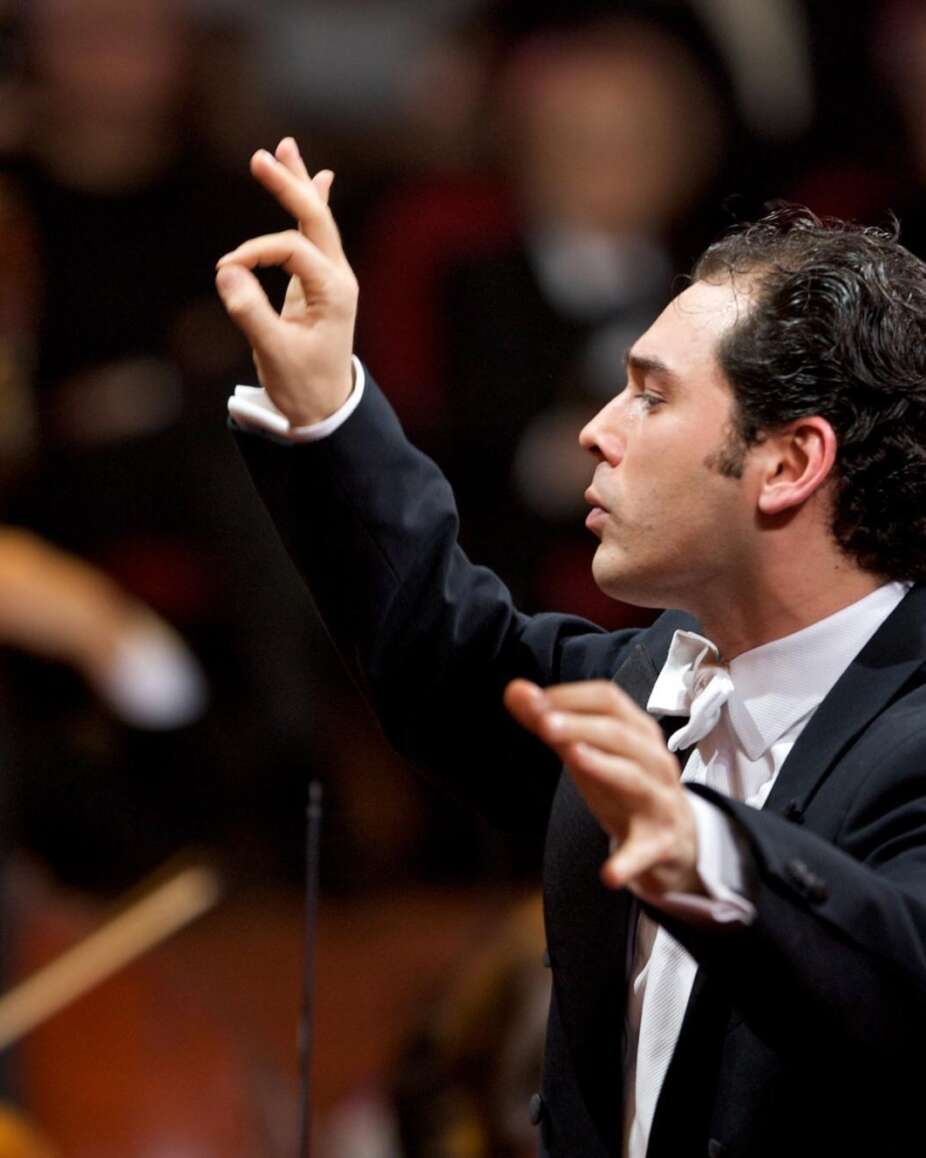
Internationally renowned conductor Tugan Sokhiev will conduct the Orchestral Concerts at the 2026 Easter Festival together with the Berliner Philharmoniker and soloists Janine Jansen, Noah Bendix-Balgley and Bruno Delepelaire. He will also conduct the Be Phil Orchestra, which consists of 75 amateur musicians and five soloists from the Berliner Philharmoniker, in a Special Concert.
The »Symphonie fantastique« is at the heart of the Orchestral Concerts, performed once with the Brahms Double concerto and once with the Bruch violin concerto. Where do you see connections between the works?
Tugan Sokhiev: The most obvious connection between these works is that they are all highly representative of the Romantic period that was dominating the culture of the 19th century in Europe, even though individually they show quite different aspects of Romanticism. All three composers were also highly influenced by Beethoven and – famously in the case of Brahms and Bruch –quite daunted by the task of living up to Beethoven’s genius as a composer.
»Symphonie fantastique« is the earliest of these pieces, but is also the most radical. It is a work of great imagination, of course and uses a huge orchestra to create new sounds and colours. Like Beethoven’s Pastoral Symphony it has five movements and each movement depicts a scene, but in Berlioz’s case the scenes are highly personal and relate directly to his own romantic situation.
Brahms’ Double concerto is also an emotional work, with extremely beautiful and lyrical melodies, but they are presented within a far more classical structure, and in a far more restrained and abstract way. There is also a personal dimension to this work, as Brahms supposedly wrote it partly to reconcile with his friend the violinist Joseph Joachim, with whom he has fallen out, but who eventually premiered the piece.
The Bruch Violin concerto is between the two, it is also very lyrical although with more expansive melodies and a warmer and more intimate feeling than the Brahms, although they both end with a rhythmic and folk-music inspired third movement. Incidentally, Joachim also helped Bruch revise the concerto after it was premiered with another violinist, and himself gave the premiere of the very much revised version.
What place does Johannes Brahms' Double Concerto occupy in his oeuvre and why is the unusual combination of violin and cello so central to this work?
Tugan Sokhiev: The Double Concerto was written towards the end of Brahms life and brings together different strands of several of the styles and forms he was associated with throughout his life: the concerto, chamber music and symphonic writing. It is a very personal work and the unusual combination of the violin and cello is significant: rather than the displays of virtuosity we see in the violin concerto and piano concerti, the soloists here are more integrated into the the writing, exchanging themes and ideas and giving the music a chamber music feel with the orchestra having equal importance to the soloists. In this music there are no flashy cadenzas and no empty virtuosity, but a dialogue between the instruments in which Brahms succeeds in combining full romantic expression in a classical structure.
What was Berlioz’s life situation when he composed the »Symphonie fantastique«? What is the basic programmatic idea?
Tugan Sokhiev: Berlioz started to compose the »Symphonie fantastique« when he was only in his twenties, and he had to decide whether to continue his medical studies or whether to follow an artistic career. He obviously chose the latter but when he composed the »Symphonie fantastique« was not yet established, did not have much money and - most importantly - was obsessively in love with an actress who did not reciprocate his feelings. Berlioz said himself that he experienced extremes of despair, jealousy, and even opium-induced hallucinations, so channeled all these experiences into the »Symphonie fantastique«, which he gave the subtitle »Episode in the Life of an Artist«.
The symphony is a vivid portrait of the psychological state of the young artist – Berlioz - overwhelmed by passion, and each of its five movements depicts a different scenario: »Reveries – Passions‘« - where we meet the young and idealistic artist, then we are taken to a ball, with its swirling and slightly mysterious waltz, to a scene in the country, where the pastoral calm becomes more foreboding and then to the opium-induced March to the scaffold, in which the artist hallucinates he has murdered the object of his desire. Finally, the fifth movement is the »Dream of a night of the sabbath«, which is a grotesque and wild witches dance, culminating with the »Dies irae«, marking the downfall of the artist.
Bruch’s violin concerto is considered one of the most popular in this genre – why?
Tugan Sokhiev: I think the popularity of the Bruch violin concerto starts with the fact that is it very immediate: there is no long orchestral introduction, just a short, melodic dialogue between the orchestra and soloist and then we are straight into the drama of the first movement, with its combination of fiery virtuosic passages and soaring, lyrical themes. It is not overly complicated or abstract music but is so masterfully written that the music evolves very naturally and is emotionally very satisfying, with lots of dramatic contrasts and sweeping, romantic melodies. As Joachim said, it is a very seductive violin concerto!
You have been closely associated with the Berliner Philharmoniker for many years. What does this relationship mean for your joint music-making?
Tugan Sokhiev: As a conductor, one of the joys of having a long-term relationship with an orchestra is that you get to know each other and develop a mutual trust. With the Berlin Philharmoniker, the exceptional technical quality of the musicians and the rich sound and culture of the orchestra is such that they are capable of responding instantly to anything I want to say in the music, so the possibilities for exploring ideas are limitless.
You are a welcome guest in Salzburg – what does the city and the festival mean to you?
Tugan Sokhiev: Thank you! For all musicians the name Salzburg is synonymous with Mozart and the festival, so it was very special when I came here for the first time, and wonderful to be immersed in music, history and the beautiful nature – in such a setting it’s impossible not to be inspired!